The Feminine Good and Evil in Middle Earth
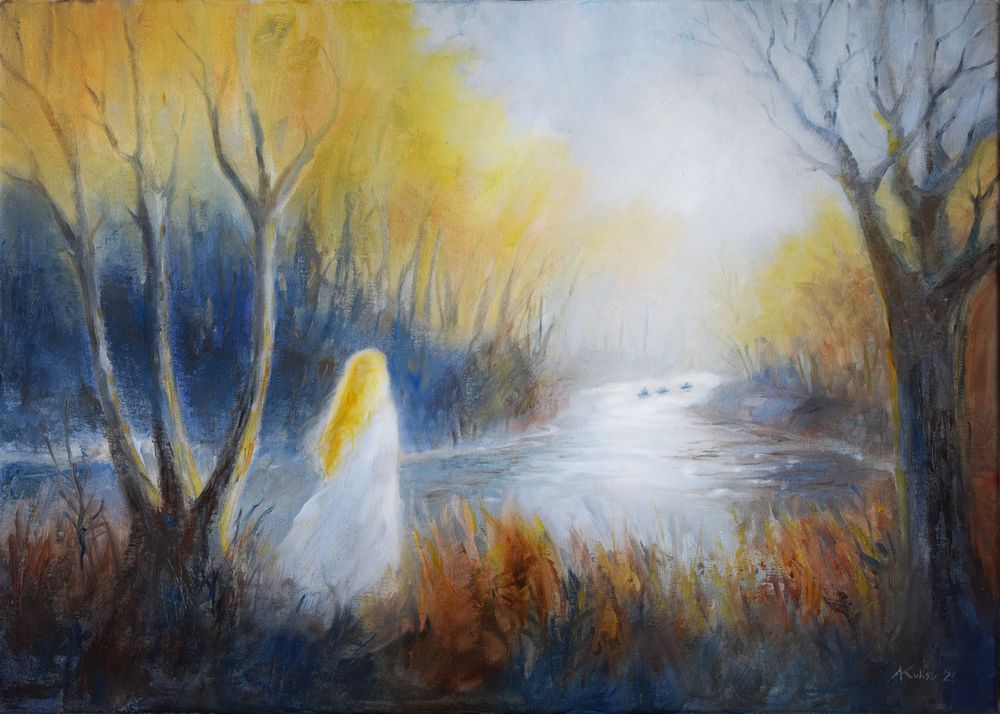
Within the theological framework of Middle Earth, J. R. R Tolkien's female characters serve as the spiritual center around which the story revolves; these assumedly distant or undeveloped women are actually not so, but should be understood as various hagiographic icons finding their fulfilment in the character of Galadriel and her opposition to the wicked mother Shelob. The women of middle earth bear a theological and symbolic weight far greater than their page count may suggest. This essay endeavors to articulate the three primary archetypes of the feminine that Tolkien constructs; wife/healer, warrior, and queen. Through an understanding of these hagiographic archetypes, their summation in the character of Galadriel, and their antithesis in the monster of Shelob, the reader can understand Tolkien's theological vision of the feminine. By exploring this symbolic structure, the reader understands that Tolkien does not marginalize women but instead elevates them to a central counterforce to evil. Shaped by his fundamentally Catholic and medieval worldview, Tolkien venerates women to the spiritual and theological heart of the epic.
The first and most common archetype is the domestic one; the wife/healer/mother figures. Though distinct in appearance and actions, these figures largely fill the same role. These women are both grounding and restoring figures to the other heroes of this story, their grounding inspires and gives council while their restoring both heals and prepares. Their actions and quality of character flow from their identity as fundamentally life-giving figures.
The first of these is Goldberry, the wife of Tom Bombadill. Joyful, hospitable, and beautiful, she bathes, feeds, and comforts the hobbits after their rescue from old man willow. She is not a warrior but renews the spirit of those who must be. As wife she is shown as the queen of her household; as wife to Tom Bombadill she reigns as the Eve of an Edenic forest.
Arwen is the greatest of this archetype, although only explicitly shown on page briefly, her presence and sacrifice shape much of the story. It is the purity and goodness of Arwen that center Aragorn in his fight against evil. It is for Arwen chiefly that Aragorn fulfills his calling to kingship, it is the banner of Arwen for Aragorn that signifies his ascent into kingship. It is the proclamation of Kingship from her as his queen that truly crowns him.
Finally, there is the image of Rosie Cotton. A seemingly simple and uninvolved girl who is, by her very act of existing, responsible for saving middle earth. Like it was for so many of Tolkien's comrades in WW1, it is the thought of this good feminine that gives hope and strength to the despairing in their darkest of hours. Sam thinks of Rosie in tandem with the shire, their goodness, joyfulness, and fertility are intertwined. Not only is she for whom Sam summons the strength to struggle for in the depths of Mordor, she is also the person with whom he restores the shire. Sam's hope of a peaceful healthy life in the shire relies on her doubly as both the person with whom to grow his own family and also with whom to heal and regrow the shire. Without even acting, Rosie's purity and goodness give life and hope to Middle Earth through Sam.
Eowyn adopts the masculine identity of Dernhelm, a fearsome warrior and rider of the Rohirim. Although she does this firstly out of fear that she be chained and minimized in the domesticated life, she does this primarily out of love for her king, compassion for her people, and protectiveness of a child/hobbit. In doing so she does what no man can do and slays the witch king of Angmar. This act is not a rebellion against femininity but her fulfilment of it, what some reduce to Tolkien's singular concession to feminism is actually the opposite. The witch king's prophecy that "not by the hand of man shall he fall" is not a linguistic loophole but instead a profound theological revelation of the nature of evil(Tolkien, 823). It is the righteous feminine that evil underestimates, the structures of domination are blind to the power of the feminine. It is only once her golden hair, pure and bright, is revealed that she, like the sun itself, is able to devastate the darkness. Although Eowyn's act was a superficially martial and masculine act, her motivations are feminine. Eowyn's triumph reveals a distinctly feminine courage and strength underlying her great victory.
After Eowyn's courage and strength are beyond any doubt she moves voluntarily into a role of healing, motherhood, and growth. She does this not as a stepping down into a cage of sexist restriction but as her ascension onto a thrown of feminine power and leadership.
Eowyn's character growth has her ascending to a queenly healer as her final form; the reader watches character Eowyn grow from faithful obscurity to glorious courage and eventually into queenship as her final form. This final form of feminine power in queenship is the direction Eowyn's feminine growth leads her by the end. This feminine queenship achieved by Eowyn has its summation in the character of Galadriel. This movement of Eowyn a human woman towards Elfhood and Galadriel can be understood as the human progressing to a more archetypal, hagiographic, iconic form.
Galadriel is the most exalted of the three archetypes, within her character are a series of paradoxes. She is ancient yet youthful, gentle yet fierce, uncorrupt yet corruptible and for all this both comforting and terrifying. She sees into hearts, discerns motives, and gives counsel and calls to action.
Her domain is Lothlorien, an Edenic sanctuary untouched by the cruelty and pain of the fallen world. Within this realm the fellowship receives comfort, healing, direction, and arming. Much like a queen in medieval literature- or Mary in the Catholic tradition- she lies both physically and spiritually at the heart of a hidden kingdom. This is reflected in her appearance, which is noticeably white and gold.
Much like a Marian figure, the primary quality of Galadriel is her purity. It is her purity that gives her significance, power, and renown. Galadriel is not pure in a simplistic way but in a meaningful way. She herself says that she vies with the power of the dark lord. She has known Sauron personally from ages past. Furthermore, she is not beyond temptation, the ring itself calls to her and she herself knows and acknowledges it; she refuses the ring and embraces humility: "I pass the test. I will diminish and go into the west"(Tolkien 381). Her temptation is even distinctly tied to her feminine goodness. The temptation of the ring to her is of devouring possessive motherhood and self-absorption. She is not pure because of ignorance but through great suffering and restraint. Much like her Marian inspiration she also, despite her vast goodness, chooses to point away from herself in humility. She chooses to give life and help rather than to take and demand it.
These life-giving gifts of Galadriel are significant and telling and indicative of her queenship. She gives safety and healing to the fellowship in their time of great despair and loss. She clothes them in her own garments, and she feeds them with her own food. These are not insignificant things either, never else did such peoples receive such gifts from the queen Galadriel. She gives food that nourishes the week and gives cloaks that shroud and shield them from darkness and evil. She gives great belts and bows to the fellowship, both signs of honor and power in her great kingdom. The gift of the Elstone to Aragorn elevates him to kingship. By giving others recognition and honor instead of demanding it she anoints Aragorn to kingship. Galadriel adorns the fellowship in her cloaks and broaches a singularly unique honor for such a fellowship demonstrating the significance of their quest to all those who see. But, going further than simple bread or banners, her food and cloak do not stop at symbolic and spiritual significance but are also essential in a very practical physical sense.
Galadriel is not merely a third feminine archetype but the summation of the others. Within her queenship she is wife, mother and healer, as well as fearsome warrior and destroyer of evil and darkness. Just as Arwen and Goldberry, she heals, sooths and protects the fellowship. Just as Rosie and Arwen, she is a guiding light to the fellowship, giving of hope and direction. Her lembas nourishes, heals, and sustains the fellowship just as the food of Goldberry does. The other women have their growth throughout the tale moving towards queenship. Rosie becomes the healing mother gardener and mayor wife, Eowyn becomes healer queen and Arwen becomes high Queen. All of this is to say, as the other women become better and more faithful versions of themselves, they become more queenly, more like Galadriel.
Jane Beal argues that Galadriel should be viewed as a hagiographic figure, as a saint of middle earth (Beal, 8). This actually aligns with Tolkien's understanding of his work as subcreation. Tolkien's writings exist as a pseudo mythic, symbolic history so it is to be expected that his world has embodiments of ideas and symbolic representations of concepts or movements. There are several things to notice about Galadriel as a hagiographic icon. The first is her sanctity through humility; she lives her life penitently repentant for her sins in millennia past, her denial of the ring is an act of perfect humility. She reflects the light of Valar and gives them glory. Much like the Virgin Mother, her beauty is not erotic but luminous and pure. Galadriel is not safe from evil because of her ignorance towards it but instead because of her humility towards it. None of this is new to this paper or Jane Beal, Tolkien himself admits in letter 134 that there are Marian influences on the character of Galadriel(Tolkien).
The most revealing recognition of her hagiographic nature comes through the dwarf prince Gimli. Galadriel's superabundant generosity, her literal giving of herself to an ancient racial enemy, serves as a sacrificial, sacramental act. By this act of giving she heals an ancient enmity and changes what could have been a moment of erotic desire or physical domination into one of reconciliation and blessing. Gimli's encasing of this gift into a holy relic to bless his people indicates the sacramental reality.
Galadriel, though not in totality, is understood to physically possess the light, goodness, and potency of the two trees of Valinor. Her hair is said to have this light and power and that is why it is able to serve as a sacred relic. Galadriel, like Mary and the saints is said to be able to reflect the light of the divine(Tolkien 367). The only gift greater than the hair she gives to Gimli is the phial she gives to Frodo. This too is a sacred relic, this too contains her physical and spiritual essence, and even more so contains what light and power of the trees of Valinor that remain in middle earth through her.
There stands opposed to Galadriel's selfless, self-giving femininity; the realization of the specific feminine temptation that Galadriel resists are found in in Cirith Ungol. The devouring mother, wicked spider spawn of primordial darkness and chaos incarnate, Shelob is specifically and significantly coded as female. Her weaving is a demonic mockery of the feminine craft; her webs do not liberate and protect but ensnare and destroy. She does not nourish her guests but feeds on them. She is not purity but foulness. She is not illuminating and guiding, but darkening and deceiving. She does not build community but fosters isolation. Her relation is domination and possession rather than liberation and selfless love. She exists as a fundamentally life taking.
Shelob exists as a horrible feminine force, she is unopposable even to the great masculine might of Mordor. She would eat Sauron himself if he dared venture close enough. Still, she is defeated, and it is a feminine force which destroys her. Galadriel gives a phial to Frodo saying it will be "a light for you in dark places, when all other lights go out;" ultimately in the physically and spiritually darkest place that is what the phial does(Tolkien 367). The Phial devastates Shelob, it burns her, blinds her, and diminishes her. This thing gives Sam strength, it gives him light, and most significantly it gives him hope and makes him cry out "Elbereth Gilthoniel." This defeat of Shelob by proxy tells much about the nature of Galadriel and feminine goodness itself in middle earth. Galadriel gives Frodo a piece of the original unfallen goodness of the world; for Tolkien it is a distinct and essentially feminine act to keep and transmit this original goodness. This goodness is not a weapon of dominating and consuming but a light that shines and reveals. It is the shining and revealing that so destroys wickedness, reflecting its destructive maliciousness upon itself. In Roman Catholicism the Rosary is the chief weapon against the demonic as the Virgin Mother reflects divine power and wrath against wickedness, in Middle Earth it is the Phial of Galadriel which reflects the divine power and light of Elbereth against Shelob.
The readers and scholars of J.R.R. Tolkien have long remarked about the scarcity of female characters in The Lord of The Rings. Furthermore, Tolkien's female characters have been described as shallow, distant, or underdeveloped; there is certainly a lacking of modern introspection, internal monologuing, or psychoanalytical nuance in these characters. Tolkien himself remarks in a 1958 letter that he does not write as many women because he fundamentally understands them less than men (Tolkien.213). Because of this, many have accused Tolkien himself, and his legendarium of sexism and misogyny. To do this is to fundamentally misunderstand the nature and literary mode of Tolkien's writings. Tolkien was not writing modernist, realist fiction in which psychoanalytical nuance and inter sexual social commentary form the center of the narrative; Tolkien was writing a mythopoetic romance. Quite differently, Tolkien writes from the perspective of a medievalist writing epic myth; in this mode of writing his characters -especially women- operate on a theological and archetypical plane. The issue stems from the fact that Tolkien writes his women symbolically and not in a modern psychological register. The proper way to understand the women of Tolkien's legendarium is actually as symbolic and archetypal hagiographic figures.
Tolkien does not force all women into a singular vision of what a "woman" is or should be but has multiple variations on multiple archetypes, all of which are important in their own right. The three archetypes- wife/healer, warrior and queen all find their summation in Galadriel, whose sanctified femininity stands opposed to the devouring, possessive femineity of the monster Shelob. This symbolic structure underlies the moral drama of the tale and undermines the accusation of misogyny, revealing that Tolkien centers the feminine as bearers of special spiritual authority rather than mere marginal adornment.
Tolkien demonstrates evil in its feminine mode not as domination and aggression (the male evil impulse) but as the perversion of the creative and relational essence of femininity into narcistic possession and consumption. This leaves the pure, self-giving feminine (namely Galadriel/Elbereth) as the only force capable of ontologically defeating such evil, as visualized in Shelob's destruction. In the Lord of the Rings, one set of mothers continually help and heal but send the children/hobbits out to do their duty to the world, the other lures and ensnares them in her home hoping to possess them all to herself.
Citations Beal, Jane. ““Saint Galadriel?: J.R.R. Tolkien as the Hagiographer of Middle-Earth.”” Journal of Tolkien Research, , illustrated by , vol. 10, no. 2, 2020. Croft, Janet Brennan, and Leslie A. Donovan. Perilous and Fair: Women in the Works and Life of J.R.R. Tolkien. Mythopoeic Press, 2015.
Hansen, Christopher. “The monstrous feminine: Ungoliant, shelob, and women in Tolkien’s Middle-Earth.” Crossroads A Journal of English Studies, no. 34(3), 2021, pp. 4–15, https://doi.org/10.15290/cr.2021.34.3.01.
Tolkien, J. R. R., et al. The Letters of J. R. R. Tolkien. HarperCollins UK, 2024.
Tolkien, J. R. R., and Christopher Tolkien. The Silmarilion. Houghton Mifflin Company, 1977.
Tolkien, J. R. R., and Wayne G. Hammond. The Lord of the Rings. HarperCollinsPublishers, 2014.
Get email updates for new blog posts by following me on Substack.